Trading in the cryptocurrency field is seen as a big deal, as it requires various skills such as timing the market, analyzing charts, understanding order books, gauging market sentiment, and recognizing trends. Successful trading relies on well-planned strategies that maximize returns while minimizing risks. These strategies serve as tools to navigate the unpredictable nature of crypto markets, enabling traders to capitalize on opportunities and safeguard their investments.
In this article, we reveal some of the most profitable and best crypto trading strategies, detailing what they are, how they work, and how you can implement them effectively.
What is the Best Crypto Trading Strategy?
Before digging deeper, let’s first understand what is meant by the best crypto trading strategy.
A best crypto trading strategy is a structured approach to trading cryptocurrencies that helps traders make informed decisions on when to buy, sell, or hold assets.
It involves:
- Analyzing market data
- Using technical indicators
- Understanding market trends to maximize returns while managing risk.
The strategy is customized to the trader's goals, risk tolerance, and market conditions, aiming for consistent performance and reducing the likelihood of losses compared to ad-hoc trading. It is always advisable to invest in top cryptocurrencies when starting, as they are a safer choice.
Best Crypto Trading Strategies for Beginners
Before learning the best crypto trading strategies for beginners, start by understanding how to invest in cryptocurrency. This foundational step is crucial for mastering the basics. This section will cover some of the proven and best crypto trading strategies for beginners and traders with various experience levels.
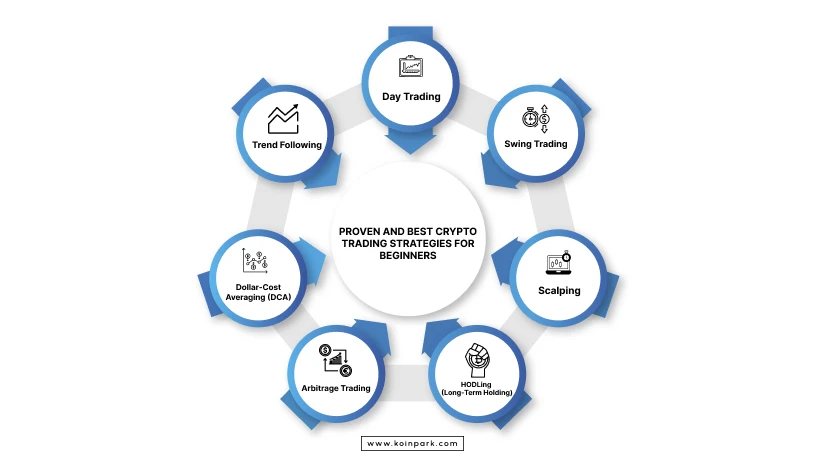
1. Day Trading
Day trading is a trading strategy where traders buy and sell cryptocurrencies within the same trading day, aiming to profit from short-term price fluctuations. Unlike long-term investing or swing trading, day traders close all their positions before the end of the trading day to avoid overnight risk and capitalize on intraday market movements.
Features
- Involves buying and selling assets within the same day to take advantage of small price fluctuations.
- Requires constant monitoring of the market.
- High-risk, high-reward due to rapid market changes.
How to Implement Day Trading Strategy?
- Choose a trusted cryptocurrency exchange like Koinpark with low fees and fast execution times.
- Select cryptocurrencies with high liquidity and volatility, such as Bitcoin or Ethereum.
- Use technical analysis tools like moving averages, RSI (Relative Strength Index), and MACD (Moving Average Convergence Divergence) to identify entry and exit points.
- Set stop-loss orders to manage risk and protect against significant losses.
- Close all positions before the end of the trading day to avoid overnight risks.
2. Swing Trading
Swing trading is a trading strategy that aims to capture short- to medium-term gains by identifying and trading on price swings or trends within a particular market. Unlike day trading, which focuses on intraday movements, swing trading typically involves holding positions for several days to weeks, allowing traders to profit from anticipated price fluctuations over a longer period.
Features
- Focuses on capturing gains within a medium-term time frame (days to weeks).
- Less stressful than day trading as it allows for more extended market analysis.
- Balances risk and reward effectively.
How to Implement Swing Trading Strategy?
- Conduct a market analysis to identify assets with a clear trend (upward or downward).
- Use indicators like Bollinger Bands, Fibonacci retracements, and support/resistance levels to find the best entry points.
- Enter the trade when the price bounces off a support or resistance level, signaling a potential reversal.
- Set stop-loss and take-profit levels to secure gains and limit losses.
- Monitor the trade over the following days or weeks, adjusting your strategy as needed based on market conditions.
3. Scalping
Scalping is a trading strategy focused on making small, quick profits from minor price changes in the market. Scalpers typically execute a high volume of trades over short periods, aiming to capitalize on small price fluctuations within a single day. The goal is to accumulate multiple small gains that can add up to significant profits.
Features
- Involves making multiple trades throughout the day, aiming for small, consistent profits.
- Extremely fast-paced, requiring quick decision-making and execution.
- Best suited for experienced traders with a deep understanding of the market.
How to Implement Scalping Trading Strategy?
- Choose a crypto exchange platform with minimal fees and lightning-fast order execution.
- Focus on highly liquid assets to ensure quick trade execution.
- Utilize 1-minute or 5-minute charts to analyze market movements.
- Enter and exit trades within minutes, focusing on minor price changes.
- Implement tight stop-loss orders and close positions as soon as the desired profit is reached.
4. HODLing (Long-Term Holding)
HODLing is a trading strategy that involves holding onto cryptocurrency assets for an extended period, regardless of market fluctuations. The term originated from a misspelling of "holding" in a 2013 Bitcoin forum post and has since become a popular term in the crypto community.
Features
- Involves buying and holding assets for an extended period, usually years.
- Low maintenance compared to other strategies.
- Relies on the belief that the asset's value will increase over time.
How to Implement HODLing Trading Strategy?
- Conduct thorough research to identify promising cryptocurrencies with strong fundamentals.
- Purchase the chosen assets and transfer them to a secure wallet (preferably hardware or cold storage).
- Ignore short-term market fluctuations and remain patient.
- Periodically review the project's progress and market conditions to ensure continued confidence in the asset.
- Consider selling portions of the holdings when significant price targets are reached or when the investment thesis changes.
5. Arbitrage Trading
Arbitrage trading is a strategy that involves buying and selling the same asset in different markets or exchanges to take advantage of price discrepancies. The goal is to profit from these differences without taking on significant market risk.
Features
- Exploits price differences of the same asset on different exchanges.
- Low-risk strategy if executed correctly, though opportunities may be short-lived.
- Requires access to multiple exchanges and quick transactions.
Read also: What is Arbitrage in Cryptocurrency Trading
How to Implement Arbitrage Trading Strategy?
- Open accounts on multiple cryptocurrency exchanges that have different pricing for the same assets.
- Monitor price differences using arbitrage tools or bots that can detect discrepancies.
- Buy the asset on the exchange where the price is lower and sell it on the exchange where the price is higher.
- Consider transaction fees and time delays to ensure profitability.
- Withdraw or reinvest the profits and repeat the process whenever opportunities arise.
6. Dollar-Cost Averaging (DCA)
Dollar-Cost Averaging (DCA) is an investment strategy where an investor consistently invests a fixed amount of money into an asset, such as a cryptocurrency or stock, at regular intervals regardless of the asset's price. This approach aims to reduce the impact of volatility by spreading out the investment over time.
Features
- Involves regularly investing a fixed amount in a particular cryptocurrency regardless of its price.
- Reduces the impact of volatility by spreading out purchases over time.
- Ideal for long-term investors.
How to Implement Dollar-Cost Averaging strategy?
- Choose a cryptocurrency to invest in, such as Bitcoin or Ethereum.
- Determine a fixed amount of money to invest at regular intervals (e.g., weekly, monthly).
- Set up automatic purchases on your exchange of choice.
- Continue the strategy regardless of market conditions, ensuring a consistent accumulation of the asset.
- Review your portfolio periodically to assess the overall performance and make adjustments if necessary.
7. Trend Following
Trend following is a trading strategy that aims to capitalize on the direction of an asset's price movement by identifying and riding trends. The core principle of trend following is to buy assets when they are in an uptrend and sell (or short) when they are in a downtrend. The goal is to profit from sustained price movements in the direction of the trend.
Features
- Relies on the principle that "the trend is your friend."
- Involves identifying and trading in the direction of the market trend.
- Requires a good understanding of technical analysis.
How to Implement Trend Following Strategy?
- Use tools like moving averages, trend lines, and the ADX (Average Directional Index) to identify the prevailing trend.
- Enter the trade when the trend is confirmed and avoid trading against it.
- Set trailing stop-loss orders to protect profits as the trend continues.
- Monitor the trade and stay disciplined by sticking to the strategy, even if minor retracements occur.
- Exit the trade when the trend shows signs of reversal or when a set profit target is achieved.
You might also like: How to Invest in Cryptocurrencies | Tips for Beginners
Advanced Crypto Trading Strategies
Advanced crypto trading strategies use complex methods to take advantage of market movements and boost profits. Unlike basic trading, these strategies need a good understanding of how the market works, along with advanced tools and detailed analysis. They are usually used by experienced traders who want to find special opportunities in the market and manage risk more effectively.
Below mentioned are some of the advanced crypto strategies that can help experienced traders optimize their trading performance.
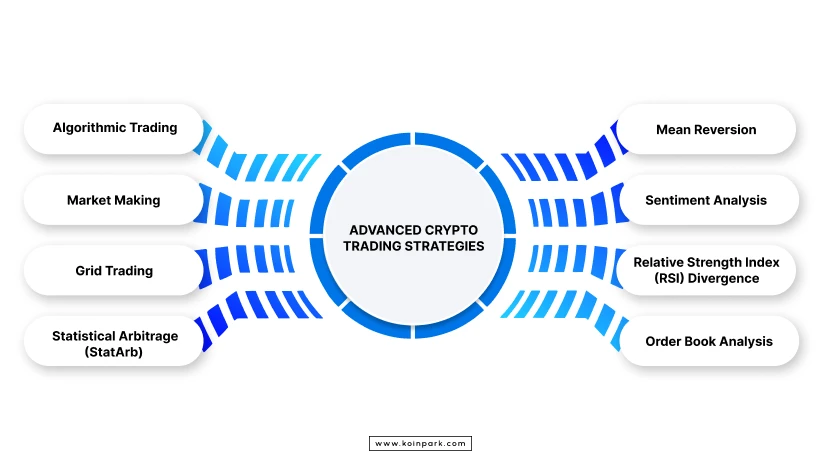
1. Algorithmic Trading
Algorithmic trading involves using automated systems to execute trades based on predefined criteria. These algorithms can process large amounts of data and execute trades faster than any human could, often within milliseconds.
Features
- Eliminates human emotions from trading decisions.
- Executes trades at optimal prices and with high precision.
- Can simultaneously monitor multiple markets and assets.
How to Implement Algorithmic Trading?
- Develop or acquire a trading algorithm that aligns with your strategy (e.g., trend-following, arbitrage).
- Backtest the algorithm using historical data to assess its performance.
- Deploy the algorithm on a trading platform that supports automated trading.
- Continuously monitor and optimize the algorithm based on real-time performance and market conditions.
- Implement strict risk management protocols to prevent significant losses due to unforeseen market events or technical failures.
2. Market Making
Market making involves providing liquidity to the market by placing buy and sell orders on both sides of the order book. Market makers profit from the bid-ask spread—the difference between the price at which they are willing to buy and sell an asset.
Features
- Generates consistent profits through the spread, regardless of market direction.
- Requires a deep understanding of market mechanics and order book dynamics.
- Can be capital-intensive, as it requires maintaining a balanced inventory of assets.
How to Implement Market Making Strategy?
- Select a cryptocurrency with high trading volume and a relatively stable price.
- Place simultaneous buy and sell orders at different price levels to capture the bid-ask spread.
- Continuously adjust orders based on market conditions and liquidity needs.
- Use sophisticated algorithms to manage inventory and minimize risk exposure.
- Monitor market depth and order flow to identify profitable opportunities and avoid adverse selection.
3. Grid Trading
Grid trading involves placing a series of buy and sell orders at predetermined intervals above and below the current market price. The strategy aims to profit from market fluctuations within a specified price range.
Features
- Ideal for markets with sideways movement or moderate volatility.
- Can generate profits in both rising and falling markets.
- Requires careful planning of grid levels to optimize returns.
How to Implement Grid Trading?
- Define a price range within which you expect the market to move.
- Set grid levels—price points at which you will place buy and sell orders.
- Execute the strategy by placing buy orders below the current price and sell orders above it.
- As the market moves, buy low and sell high, capturing profits within the grid.
- Regularly adjust grid levels based on market trends and volatility to maintain profitability.
4. Statistical Arbitrage (StatArb)
Statistical arbitrage involves identifying and exploiting price inefficiencies between correlated assets. This strategy often uses statistical models to predict short-term price movements based on historical data and relationships between assets.
Features
- Relies on quantitative analysis and complex mathematical models.
- Typically used in high-frequency trading environments.
- Requires access to large datasets and advanced computing resources.
How to Implement Statistical Arbitrage Strategy?
- Identify a pair or basket of correlated assets that historically move together (e.g., Bitcoin and Ethereum).
- Develop a statistical model to detect deviations from the expected relationship.
- Enter trades when the price of one asset deviates from its predicted value relative to the other asset(s).
- Close the trade when the prices revert to their mean or when a predefined profit target is reached.
- Continuously refine the model to adapt to changing market conditions and improve accuracy.
5. Mean Reversion
Mean reversion is based on the idea that asset prices tend to revert to their historical average over time. This strategy involves identifying assets that have deviated significantly from their mean and betting on a return to that average.
Features
- Works well in markets with low volatility and a stable historical trend.
- Requires careful analysis of historical data and identification of mean levels.
- Can be used in conjunction with other strategies, such as momentum or contrarian trading.
How to Implement Mean Reversion Strategy?
- Identify assets with a clear historical mean or average price level.
- Use technical indicators like Bollinger Bands, moving averages, or RSI to detect overbought or oversold conditions.
- Enter trades when the asset's price deviates significantly from the mean, expecting a reversion.
- Set stop-loss and take-profit levels based on the distance from the mean and market volatility.
- Monitor the trade and exit when the price approaches the mean or when the market conditions change.
6. Sentiment Analysis
Sentiment analysis involves using data from social media, news, and other sources to gauge market sentiment and predict price movements. This strategy is based on the belief that public sentiment can significantly impact market prices, especially in the cryptocurrency space.
Features
- Leverages big data and machine learning to analyze large volumes of unstructured data.
- Can provide early signals of market shifts before they are reflected in price.
- Highly adaptable to changing market conditions and emerging trends.
How to Implement Sentiment Analysis?
- Collect data from various sources, including social media platforms, news outlets, and forums.
- Use natural language processing (NLP) and machine learning algorithms to analyze the sentiment of the data.
- Develop sentiment scores that correlate with bullish or bearish market conditions.
- Enter trades based on sentiment signals, with a focus on timing and market reaction.
- Continuously refine the sentiment models to improve accuracy and reduce false signals.
7. Relative Strength Index (RSI) Divergence
RSI divergence is a strategy that uses the Relative Strength Index (RSI) to identify potential reversals in price trends. Divergence occurs when the price of an asset moves in the opposite direction of the RSI, indicating a potential change in trend.
Features
- Effective in identifying early signs of trend reversals.
- Combines technical analysis with price action for more accurate predictions.
- Works well in both trending and range-bound markets.
How to Implement RSI Divergence?
- Apply the RSI indicator to the asset's price chart, typically using a 14-period setting.
- Identify instances where the price is making higher highs or lower lows, while the RSI is making lower highs or higher lows (bullish or bearish divergence).
- Enter trades in the direction opposite to the price trend when divergence is confirmed.
- Use stop-loss orders to protect against false signals, and set profit targets based on the expected reversal.
- Monitor the trade and exit when the price moves significantly in the direction of the divergence or when the RSI returns to neutral levels.
8. Order Book Analysis
Order book analysis involves studying the buy and sell orders on an exchange to understand market sentiment and predict short-term price movements. This strategy provides insights into market depth, liquidity, and potential support and resistance levels.
Features
- Offers real-time insights into market activity and trader behavior.
- Helps identify potential areas of price manipulation or large orders that could move the market.
- Requires a keen understanding of market microstructure and trading psychology.
How to Implement Order Book Analysis?
- Monitor the order book of the cryptocurrency you are trading, paying attention to the distribution of buy and sell orders.
- Identify large buy or sell walls, which can act as support or resistance levels.
- Use the order book to gauge market sentiment—whether there is more buying or selling pressure.
- Enter trades based on the anticipated reaction to large orders, liquidity gaps, or imbalances in the order book.
- Continuously adjust your strategy as new orders enter the book and as the market evolves.
Conclusion
Profitable crypto trading strategies require a combination of knowledge, discipline, and risk management. By choosing the strategy that aligns with your trading style and risk tolerance, you can maximize your chances of success in the crypto market. Whether you're a day trader looking for quick profits or a long-term investor with a vision for the future, there’s a strategy out there that can help you achieve your financial goals.
Remember, no strategy is foolproof, and it's essential to continually educate yourself and adapt to the continuously changing crypto industry.