The cryptocurrency industry is always changing and full of new ideas. One of these is token burning, which has become quite popular lately.
But what is token burning exactly, and why does it matter for cryptocurrency users and investors? This article will cover all about token burning.
What is Token Burning?
Token burning is a process of permanently removing cryptocurrency tokens from circulation. This is usually done by sending them to an "eater address" which nobody has the private key to access.
Once the tokens are sent to the eater address, they become unspendable and effectively destroyed, reducing the total supply of tokens in circulation.
Understanding Token Burning
- Token burning is typically initiated by the developers of a particular cryptocurrency, and for various reasons.
- One common reason is to increase the scarcity and perceived value of the remaining tokens.
- By reducing the supply, the developers hope to create a more valuable and attractive token for investors, and potentially drive up the price.
- Another reason for token burning is to control inflation.
- If the rate of token creation is higher than the rate of adoption and usage, it could lead to oversupply and eventual devaluation of the token.
- Burned tokens serve as a mechanism to alleviate this problem, by reducing the total supply and maintaining a healthy balance between demand and supply.
- This is applicable for coin burning too.
Why Does Token Burning Matter?
Token burning can have significant implications for the value and utility of a cryptocurrency, and for the community or ecosystem surrounding it. Here are a few reasons why token burning matters:
1. Increased Scarcity and Value
As mentioned earlier, token burning can increase the perceived value of a cryptocurrency by reducing its supply. If the demand for the token remains the same or increases, this could lead to a price increase per token.
2. Greater Control Over Supply
Token burning allows cryptocurrency developers to have greater control over the supply and demand of their currency. It helps to prevent the devaluation of the token through inflation, while also making it less prone to manipulation and speculation.
3. Improved Security and Efficiency
By burning tokens, developers can also enhance the security and efficiency of their blockchain. This is because fewer unspent tokens remain in circulation, making it easier to manage the network and reduce the risk of malicious attacks.
Examples of Token Burning
There are many examples of cryptocurrency projects that have implemented token burning in one way or another. Some of the most well-known include:
- Binance Coin (BNB): Binance, one of the world's largest cryptocurrency exchanges, periodically burns a portion of BNB tokens used for transaction fees. This helps to reduce the supply and increase the value of the remaining tokens.
- TRON (TRX): TRON, a decentralized platform for content sharing and entertainment, uses a portion of its transaction fees to burn TRX tokens. This helps to control inflation and increase transaction speed.
- Ethereum (ETH): Ethereum, the second-largest cryptocurrency by market cap, recently implemented a proposal to burn a portion of the ETH transaction fees. This is intended to reduce the total supply and improve network efficiency.
Step-by-Step Coin Burning Mechanism
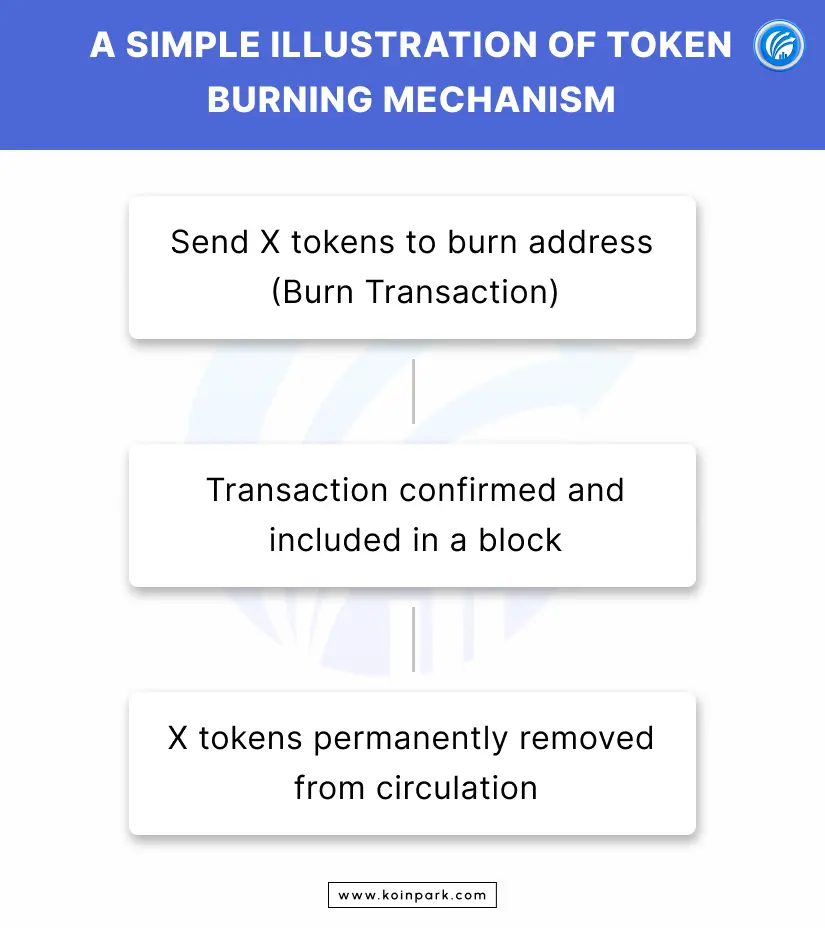
Coin burning can be executed in various ways, depending on the blockchain technology and the specific mechanisms implemented by the cryptocurrency project. Here's an illustration of a simple coin burning process:
Step 1: Designation of Burn Address
- The cryptocurrency project designates a specific public address as the burn address.
- Coins sent to this address are considered permanently removed from circulation.
Step 2: Initiation of Burn Transaction
- A user or the project itself initiates a transaction to send a certain amount of the cryptocurrency to the burn address.
- This transaction is recorded on the blockchain like any other transaction.
Step 3: Confirmation on the Blockchain
- The transaction is broadcast to the network of nodes that maintain the blockchain.
- Miners or validators confirm the transaction and include it in a block.
Step 4: Permanent Removal from Circulation
- Once the transaction is confirmed and included in a block, the coins sent to the burn address are effectively removed from circulation.
- They cannot be spent or accessed by anyone, as the private key to the burn address is typically destroyed or kept inaccessible.
Step 5: Visibility and Transparency
- The burn transaction and the associated amount of coins removed from circulation are publicly visible on the blockchain.
- Anyone can verify the transaction and confirm that the coins have indeed been burned.
Here's a simple illustration of this process:
Bottom Line
Token burning is an important concept in the field of cryptocurrency, which can have significant implications for users and investors. By reducing the total supply of tokens in circulation, developers can increase the perceived value and control the supply of their currency. This can lead to a healthier and more resilient ecosystem, with stronger security and efficiency. It remains to be seen how widespread token burning will become, but it's clear that it will continue to be an important tool for cryptocurrency developers in the years to come.