The world of finance is undergoing a transformation, with new concepts like CeFi (Centralized Finance) and DeFi (Decentralized Finance) emerging alongside traditional financial systems. But what exactly are they, and how do they differ? This blog will let you know the answers in an understandable manner. Stick around with this to educate yourself better.
First, What’s actually a CeFi?
CeFi, or Centralized Finance, is a traditional financial system where transactions occur through centralized entities like banks. It contrasts with DeFi by relying on intermediaries, prioritizing security and regulatory compliance but prompting concerns about centralization and potential vulnerabilities.
The Key Difference between CeFi and DeFi
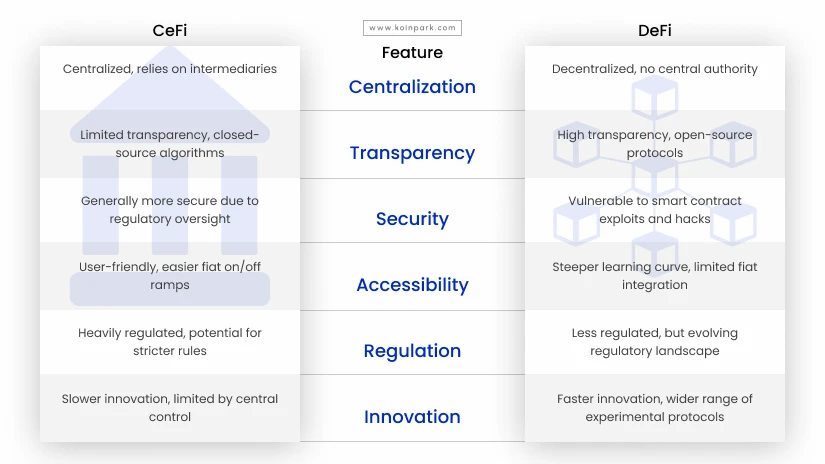
Centralized Finance (CeFi) stands on three key pillars: reliance on central entities, strict adherence to regulations, and the crucial role of trusted intermediaries. Let's delve into each of these aspects:
1. Centralized Entities
Imagine a bustling marketplace where banks, brokerages, and exchanges act as the vendors. This is the essence of CeFi. These institutions hold the reins, controlling access to financial products and services. They provide investment options like stocks, bonds, and mutual funds, facilitate transactions like payments and money transfers, and offer services like wealth management and insurance.
2. Regulatory Compliance
CeFi operates within a defined set of rules established by regulatory bodies like central banks and financial authorities. These regulations aim to protect consumers, ensure market stability, and prevent financial crimes. CeFi institutions must comply with these regulations, which can involve reporting requirements, capital adequacy standards, and Know Your Customer (KYC) procedures.
3. Trusted Intermediaries
In the CeFi world, banks and financial institutions act as trusted custodians of your assets. They hold your money, manage your investments, and facilitate transactions on your behalf. This intermediary role adds a layer of security and convenience, as you don't have to directly handle complex financial operations. However, it also creates a certain level of dependence, as your access to and control over your finances are ultimately subject to the institution's policies and procedures.
CeFi in Short
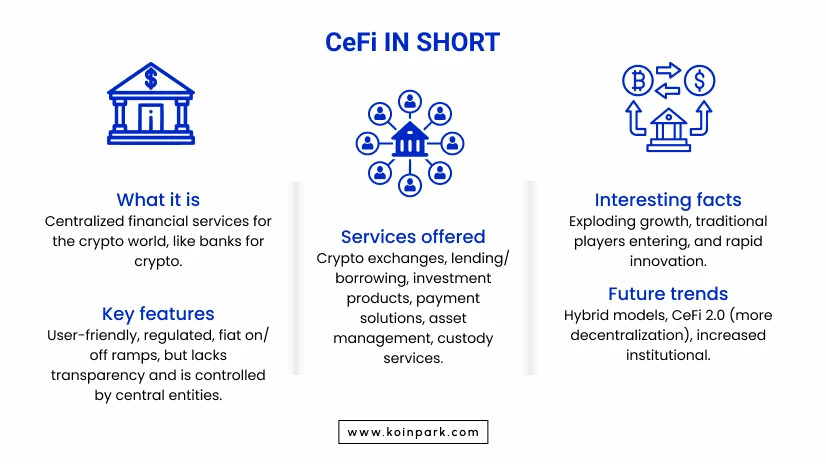
Implications of Centralization
The centralized nature of CeFi comes with both advantages and disadvantages:
Pros
- Familiarity and Security: CeFi offers established infrastructure and user-friendly interfaces, making it familiar and comfortable for many people. Additionally, regulations and oversight contribute to a sense of security for users.
- Consumer Protection: Regulatory frameworks provide safeguards against fraud and financial misconduct, offering a degree of protection to CeFi users.
- Convenience and Ease of Use: Centralized institutions handle complex financial processes, making it easier for individuals to manage their finances without needing in-depth financial knowledge.
Cons
- Limited Control: Users ultimately cede control over their finances to central entities, potentially restricting their investment options and decision-making ability.
- Lack of Transparency: CeFi institutions may not always provide full transparency into their operations and decision-making processes.
- Potential for Censorship: Centralized entities have the power to restrict access to financial services or block transactions, raising concerns about potential censorship.
Familiar Faces of CeFi: Traditional Banks and Centralized Crypto Exchanges
When it comes to CeFi, two prominent examples readily come to mind: traditional banks and centralized cryptocurrency exchanges. Let's see how they embody the core characteristics of CeFi:
1. Traditional Banks
- Quintessential Centralization: Banks are the epitome of centralized finance. They act as custodians of your money, holding deposits, facilitating payments, and offering loans and other financial products. You entrust them with your financial information and rely on their infrastructure for managing your finances.
- Regulation and Compliance: Banks operate under strict regulations set by central banks and financial authorities. These regulations cover areas like capital adequacy, consumer protection, and anti-money laundering, ensuring a degree of stability and security within the financial system.
- Trusted Intermediaries: Your bank acts as a trusted intermediary in most financial transactions. They handle complex processes like clearing and settlement, ensuring the smooth flow of funds and protecting you from potential fraud.
2. Centralized Cryptocurrency Exchanges
- Gateways to Crypto: These platforms enable users to buy, sell, and trade cryptocurrencies like Bitcoin and Ethereum. They act as central hubs, holding user funds and facilitating transactions between buyers and sellers.
- Compliance and Regulation: As the cryptocurrency industry matures, centralized exchanges are increasingly subject to regulations. KYC/AML requirements are becoming commonplace, and some exchanges even obtain licenses to operate in specific jurisdictions.
- Intermediary Role: While eliminating the need for traditional banks, centralized exchanges still act as intermediaries in crypto transactions. Users deposit their fiat currency or crypto holdings onto the platform to participate in trading activities.
Recent Developments and Innovations
CeFi isn't sitting still. To stay relevant, it's actively embracing new technologies:
- Blockchain Integration: Some banks are exploring blockchain for faster settlements and enhanced transparency. JPMorgan Chase and IBM joined forces on a blockchain trade finance platform.
- AI-Powered Services: AI is being used for fraud detection, personalized financial advice, and even algorithmic trading. Robo-advisors are becoming increasingly popular for wealth management.
Future Trends and Predictions
CeFi's future is likely intertwined with key trends:
- Tech Infusion: Expect deeper integration of blockchain, AI, and big data for streamlined services, smarter investment tools, and enhanced security.
- Regulatory Clarity: As regulations for crypto and DeFi evolve, CeFi could benefit from clearer frameworks, potentially attracting more institutional investors.
- Hybrid Models: Merging CeFi's security and DeFi's innovation might arise, like regulated tokenized assets or CeFi platforms offering DeFi access.
- Cybersecurity Focus: With rising cyber threats, CeFi will need to prioritize robust security measures to maintain user trust and confidence.
Bottom Line
CeFi, with its established infrastructure and regulatory framework, has served as the cornerstone of traditional finance for decades. However, its centralized nature presents limitations in terms of control, transparency, and accessibility.
As DeFi emerges with its promise of disintermediation and open participation, CeFi is adapting by embracing technology, forging partnerships, and exploring innovative models.
The future of CeFi likely lies in its ability to strike a balance between innovation and regulation, offering users a secure, user-friendly, and evolving financial experience. While DeFi presents challenges, it also provides opportunities for collaboration and integration, potentially leading to a more inclusive and dynamic financial ecosystem. Whether CeFi can maintain its dominance or find new niches in a hybrid future remains to be seen, but its adaptability and willingness to innovate will be key to its continued relevance in the ever-evolving financial landscape.